School gardens in Cameroon can help children connect what they learn in class with the environment around them. A patch of soil can prompt questions about plants, water, weather and how people care for the land. But a garden becomes a learning space when teachers have the confidence and support to guide those questions.
H4BF has a foundation to build on. Its 2021 annual report recorded school gardens in about 15 schools, including environmental gardens in four schools. Its 2022 report recorded environmental gardens in six schools. The reports describe these activities as a way to encourage environmental protection, environmental management and sustainable agriculture.
Why school gardens in Cameroon matter
The need for practical environmental learning is clear in the communities H4BF serves. On 20 March 2026, H4BF assessed 300 teachers across 50 schools in Bamenda I and Bamenda II. The assessment found that 68% had received no recent training in climate or environmental education, 63% lacked confidence leading practical lessons on local environmental issues, and 74% lacked suitable teaching materials. Yet 82% wanted hands-on training and resources connected to local life.
Six focus group discussions added important context. Teachers described difficulty turning environmental topics into practical classroom activities. The findings show a gap between what teachers want to do and the support they have available.
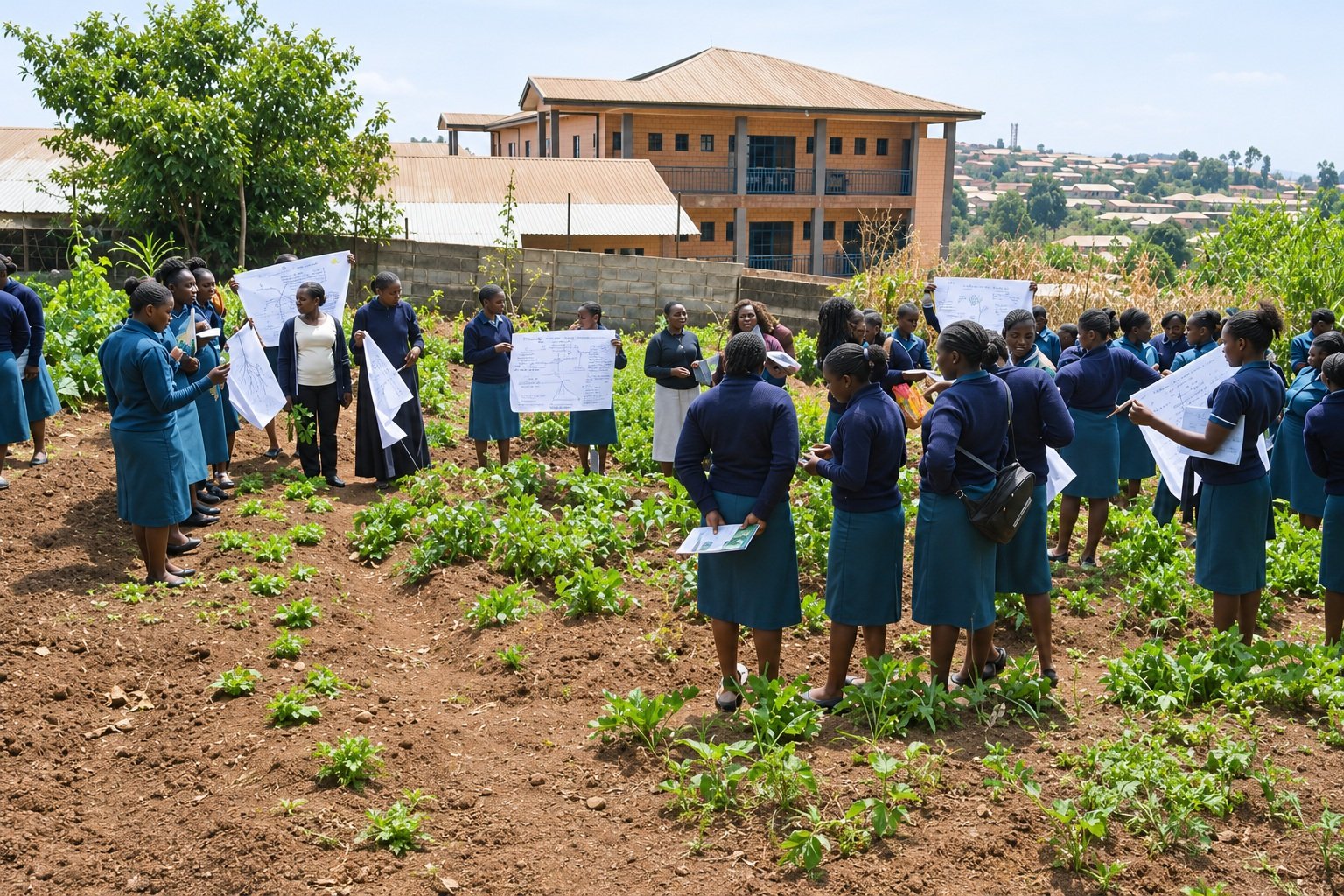
Five ways a garden can grow learning
1. Make science visible. Children can observe how a seed grows, compare shaded and sunny areas, or record changes in a plant over time. Their observations give teachers a starting point for lessons and discussion.
2. Connect learning to local challenges. Teachers can use the school environment to explore questions about soil, water, waste and plant life. Local examples can make environmental topics easier to discuss and relate to daily experience.
3. Add movement, teamwork and play. A future school activity could use team challenges such as a nature observation hunt or a water-saving relay. The aim would be learning and cooperation, not simply winning. Activities should be safe, accessible and possible with low-cost materials.
4. Give teachers practical support. Teachers need time to plan, try activities, share what happened and learn from one another. Training, lesson ideas and peer discussion can help make outdoor learning manageable in different schools.
5. Track what children and teachers learn. Lesson records, pupils’ work and teacher reflections can help schools see which activities are useful and what needs to change. This also gives partners better evidence of progress.
These are ways the approach could develop; they are not all activities H4BF has already delivered. H4BF’s published reports document its school-garden work, while the March 2026 assessment documents teachers’ needs. Together, they point to an opportunity: connect the existing school-based work with stronger teacher support and careful learning records.
School gardens in Cameroon can also make teamwork visible. Children can take turns observing, recording and caring for a shared space while teachers connect those activities to science and environmental topics. A future Green Learning League could add friendly team challenges, such as a short, safe nature-observation relay, with recognition for teamwork, inclusion and improvement rather than expensive displays. This is a proposed idea, not an activity H4BF has already delivered. Recording pupils’ work and teacher reflections would help show what was learned and what support schools still need.
Help turn school grounds into learning spaces
Donor support could help H4BF work with teachers and education partners to strengthen practical environmental learning, document what is effective and share useful lessons with other schools. With the right support, a garden can become more than a planted space. It can help children notice, ask questions, work together and learn how their environment is connected to their lives.
Partner with H4BF to help teachers make environmental learning practical, engaging and locally relevant.
Sources: H4BF 2021 Annual Report; H4BF 2022 Annual Report. Teacher-assessment findings are from H4BF’s assessment conducted on 20 March 2026.
H4BF’s environmental sustainability work.



School gardens in Cameroon can help children connect what they learn in class with the environment around them. A patch of soil can prompt questions about plants, water, weather and how people care for the land. But a garden becomes a learning space when teachers have the confidence and support to guide those questions.
H4BF has a foundation to build on. Its 2021 annual report recorded school gardens in about 15 schools, including environmental gardens in four schools. Its 2022 report recorded environmental gardens in six schools. The reports describe these activities as a way to encourage environmental protection, environmental management and sustainable agriculture.
Why school gardens in Cameroon matter
The need for practical environmental learning is clear in the communities H4BF serves. On 20 March 2026, H4BF assessed 300 teachers across 50 schools in Bamenda I and Bamenda II. The assessment found that 68% had received no recent training in climate or environmental education, 63% lacked confidence leading practical lessons on local environmental issues, and 74% lacked suitable teaching materials. Yet 82% wanted hands-on training and resources connected to local life.
Six focus group discussions added important context. Teachers described difficulty turning environmental topics into practical classroom activities. The findings show a gap between what teachers want to do and the support they have available.
Five ways a garden can grow learning
1. Make science visible. Children can observe how a seed grows, compare shaded and sunny areas, or record changes in a plant over time. Their observations give teachers a starting point for lessons and discussion.
2. Connect learning to local challenges. Teachers can use the school environment to explore questions about soil, water, waste and plant life. Local examples can make environmental topics easier to discuss and relate to daily experience.
3. Add movement, teamwork and play. A future school activity could use team challenges such as a nature observation hunt or a water-saving relay. The aim would be learning and cooperation, not simply winning. Activities should be safe, accessible and possible with low-cost materials.
4. Give teachers practical support. Teachers need time to plan, try activities, share what happened and learn from one another. Training, lesson ideas and peer discussion can help make outdoor learning manageable in different schools.
5. Track what children and teachers learn. Lesson records, pupils’ work and teacher reflections can help schools see which activities are useful and what needs to change. This also gives partners better evidence of progress.
These are ways the approach could develop; they are not all activities H4BF has already delivered. H4BF’s published reports document its school-garden work, while the March 2026 assessment documents teachers’ needs. Together, they point to an opportunity: connect the existing school-based work with stronger teacher support and careful learning records.
School gardens in Cameroon can also make teamwork visible. Children can take turns observing, recording and caring for a shared space while teachers connect those activities to science and environmental topics. A future Green Learning League could add friendly team challenges, such as a short, safe nature-observation relay, with recognition for teamwork, inclusion and improvement rather than expensive displays. This is a proposed idea, not an activity H4BF has already delivered. Recording pupils’ work and teacher reflections would help show what was learned and what support schools still need.
Help turn school grounds into learning spaces
Donor support could help H4BF work with teachers and education partners to strengthen practical environmental learning, document what is effective and share useful lessons with other schools. With the right support, a garden can become more than a planted space. It can help children notice, ask questions, work together and learn how their environment is connected to their lives.
Partner with H4BF to help teachers make environmental learning practical, engaging and locally relevant.
Sources: H4BF 2021 Annual Report; H4BF 2022 Annual Report. Teacher-assessment findings are from H4BF’s assessment conducted on 20 March 2026.
H4BF’s environmental sustainability work.
Share This:
H4BF